How It Works
From the magnetic field through the radio pulse and the gradients to the cross-section: the five steps at a glance.
Keep readingMagnetic Resonance Imaging
An MRI image is built without any X-rays. It comes entirely from the signals that hydrogen nuclei give off inside a strong magnetic field. Everything we explain here rests on that one idea. Spinschicht is an independent resource for curious readers who want to understand what happens inside the scanner before a cross-section appears on the screen.
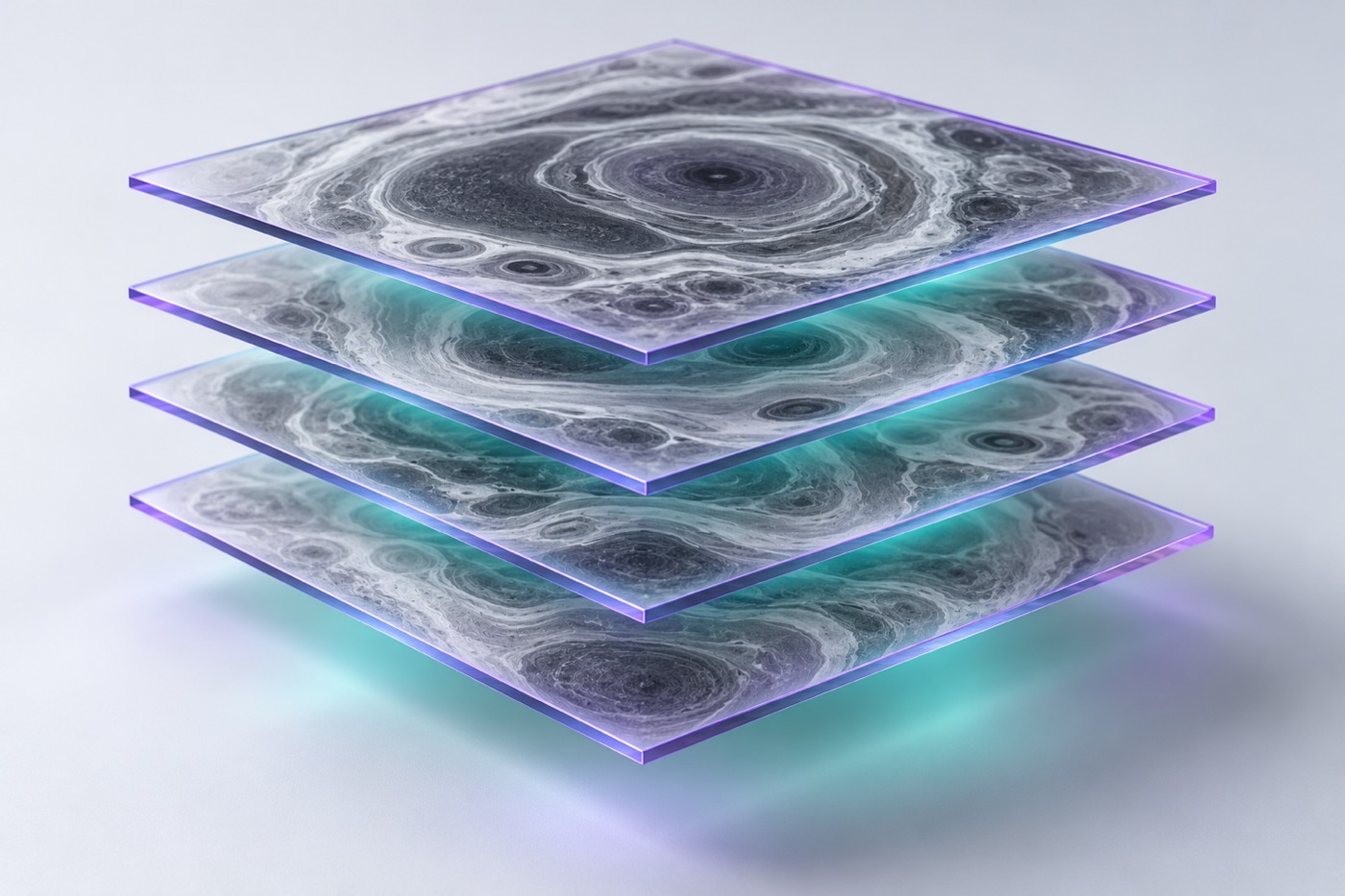
We explain magnetic resonance imaging, also called MRI, in language that needs no physics degree. The questions we answer are why hydrogen nuclei react to a magnetic field, how radio waves help read out their signal, and how that signal turns into a picture. Our writing is factual, and we simplify only as far as the core of the subject stays intact.
You can read each topic at your own pace and go deeper on its own page. Spinschicht is not a health guide, and we do not give medical advice. If you have questions about your own health, a doctor is the right person to ask.
Think of this home page as a map of five topics. The first covers the working principle, meaning the path from the magnetic field and the radio pulse to the signal from which the machine calculates an image. The second explains image contrast with T1 and T2, which can make the same part of the body look very different on two scans. The third presents the design of a scanner, and the fourth tells the history of the method.
The fifth topic is safety in the examination room. Because a very strong magnetic field is always at work in the scanner, we treat this area separately and with extra care. That makes it easier to see why certain rules apply in such a place. The text does not replace instructions from the staff, however.
From the magnetic field through the radio pulse and the gradients to the cross-section: the five steps at a glance.
Keep readingWhy the same tissue looks bright on one scan and dark on another, and what the sequence has to do with it.
Keep readingThe magnet, gradient coils, receiver coils and computer, seen from the inside out.
Keep readingFrom nuclear magnetic resonance and the first image in 1973 to the Nobel Prize in 2003.
Keep readingWhy a permanently strong field and loud noise call for special rules in that room.
Keep readingWe stick to statements that can be checked and add nothing we cannot back up. Each page is built around one central question, such as where the signal comes from, or what separates a T1 image from a T2 image. That lets you work through a subject step by step without jumping back and forth between difficult terms.
We explain harder technical words the first time they appear. You can keep reading smoothly, even if physics mostly reminds you of school.
Spinschicht is independent and does not speak for any institution or society. Our texts have a single goal: to show, in an interesting and honest way, how this method works.
If the subject is new to you, start with how it works and then move on to contrast with T1 and T2. If you are drawn to technology, open the article on scanner design. If you would like to know how it all began, read the history of the method. Enjoy the reading, and enjoy finding out how magnetic resonance imaging turns the signals of hydrogen nuclei into a picture.
The sites below deal with subjects outside our own topic, and we list them here as extra destinations for curious readers.
australian indie music
Australian indie music grew out of small venues, college radio and independent labels across the country. Its guitar bands and bedroom producers often sound quite different from their counterparts overseas.
catholic writers
Catholic writers work in many forms, from novels and poetry to essays and devotional books. What ties them together is an interest in faith, tradition and how both shape everyday life.
welsh rugby history
Rugby union holds a special place in Welsh public life, and its story runs from village clubs to packed national stadiums. The history of the game there is full of famous players, fierce rivalries and memorable seasons.
cuban genealogy research
Tracing a family back through Cuba often means working with parish registers, civil records and papers kept by relatives abroad. Researchers also have to account for waves of migration that scattered families across several countries.
dc punk scene
The punk scene in Washington, DC took shape in the late 1970s and became known for fast, fiercely independent music. It also helped spread a do-it-yourself approach to making records and running shows.
yorkshire industrial heritage
Yorkshire's industrial past includes wool mills, steelworks, coal mines and canals that carried goods through the region. Many of those buildings still stand and offer a vivid look at how work and towns once developed together.
minor league hockey
Minor league hockey is where many players sharpen their skills on the way to the top level of the sport. The smaller arenas and loyal local crowds give these teams a character of their own.
scottish clan history
Scottish clans were extended families bound by a shared name, a territory and a chief. Their history touches on tartans, castles, old feuds and the migrations that carried Highland names around the world.
lincoln county wyoming
Lincoln County lies in western Wyoming, in a landscape of mountain valleys, rivers and small towns. Ranching, outdoor recreation and local heritage all play a part in how people there describe their home.
arabic music guide
Arabic music draws on a long tradition of maqam scales, rich vocal styles and instruments such as the oud and the qanun. A good guide helps newcomers tell regional styles apart and find artists worth hearing.
summer learning loss
Summer learning loss describes how students can slip back in reading and math skills during the long break from school. Teachers and parents counter it with reading routines, light practice and enriching activities.
western mystery tradition
The Western mystery tradition gathers a wide body of esoteric thought that grew up in Europe over many centuries. Its themes include symbolism, ritual, myth and the inner journey of the individual.
kuala lumpur neighbourhoods
Kuala Lumpur is a patchwork of districts, each with its own mix of food, architecture and street life. Getting to know the neighborhoods one by one is the best way to understand how the capital fits together.
western australia art
Art from Western Australia reflects a vast coastline, red desert country and a strong Indigenous heritage. Galleries, public murals and regional festivals keep a lively creative community in view.
front wheel drive mopar
Chrysler built many of its compact and mid-size cars with front wheel drive, and fans of Mopar machines enjoy tracing that engineering. Owners swap tips on restoration, parts and the quirks of these less common classics.
new media art
New media art covers work made with digital tools, from interactive installations to generative visuals and online projects. It asks how technology changes the way artists make things and how audiences take part.
independent record label
An independent record label operates outside the major music companies and often builds its catalog around a particular sound or scene. Small labels tend to give artists more creative control, though they work with modest budgets.
interdisciplinary arts festival
An interdisciplinary arts festival brings together music, theater, visual art and performance under one roof. Audiences get to see how different creative fields respond to the same ideas.
maine outdoor adventures
Maine offers rocky coastline, deep forests, lakes and plenty of trails for hiking, paddling and camping. Visitors who plan ahead can pair a day on the water with a quiet evening by a lakeside fire.
fractal art
Fractal art starts from mathematical formulas that repeat the same pattern at ever smaller scales. The result is intricate imagery, full of spirals and branching shapes, that seems to go on forever when you zoom in.